10 days of silence and over 100 hours of meditation: my experience at a Vipassana retreat.

I recently spent 10 days totally disconnected from today’s hyperconnected world. Secluded in a meditation retreat called Dhamma Pajjota, located in Dilsen-Stokkem, Belgium. I went there to learn Vipassana, one of India’s most ancient techniques of meditation. Taught since more than 2500 years ago as a universal remedy for universal ills. This basically meant no talking. No physical and eye contact with any of the other 100 meditators participating. No phones or technology. No contact with the outside world. No music. No reading. No writing. No moving during sittings of strong determination. The morning gong rings at 4 a.m. sharp to awake everyone before the opening 4:30–6:30 a.m. meditation session. The first two of 10 1/2 total hours of meditation scheduled every single day. For 10 days straight.

I’ve got in contact with Yoga at the age of 16, when my grandmother, a Yoga teacher taught me my first sun salutation. Ever since, and over the last 15 years I’ve tried different yoga and meditation techniques, but I’ve always had ups and downs with no better results than a random and unpredictable and elusive sense of slight serenity and the pride that comes when you tell yourself “today I’ve meditated”. Nothing wrong with that, but it seemed there was more potential waiting for me somewhere. Deciding to spend ten days learning yet another technique was not an easy decision, especially meaning this going away from my household responsibilities and the caring of my daughter and partner.

If I wanted different results I would have to do things differently, right? Well, this course looked different enough. When my friend Ameet told me was going to do it, it was enough of a trigger for me to join him. So I also signed up to join a 10-day course, got on the waiting list, and luckily got a free space near the beginning date.

The Vipassana meditation technique is taught at ten-day residential courses all over the world, during which participants learn the basics of the method, and practice sufficiently to experience its beneficial results. There are no charges for the courses – not even to cover the cost of food and accommodation. All expenses are met by donations from people who, having completed a course and experienced the benefits of Vipassana, wish to give others the opportunity to also benefit. In short, Vipassana is a way of self-transformation through self-observation. It focuses on the deep interconnection between mind and body, which can be experienced directly by disciplined attention to the physical pleasant or unpleasant sensations that form the life of the body, and that continuously interconnect and condition the life of the mind. It is this observation-based, self-exploratory journey to the common root of mind and body that dissolves mental impurity, resulting in a balanced mind full of love and compassion.

The course requires hard, serious work. And once you sign up, you also agree to stay during the whole duration of the course, no matter what.  

What do you actually learn during these ten days?

There are three major parts to the 10-day training. These are Anapana, Vipassana, and Metta.

The first part, called Anapana, is to develop some short-term and experienceable mastery over the mind by learning to fix one’s attention on the natural reality of the ever-changing flow of breath as it enters and leaves the nostrils. The first three days involve over 30 hours of sitting just doing exactly that.

The second part starts by the fourth day, as the mind is calmer and more focused, better able to undertake the practice of Vipassana itself: observing pleasant and unpleasant sensations throughout the body, understanding their nature, and developing equanimity by learning not to react to them. Becoming aware of your cravings and aversions to these sensations.

Finally, on the last full day, participants learn Metta, a meditation of loving kindness, happiness, peace, and goodwill towards all, in which the purity developed during the course is shared with all beings.

The entire practice is actually a mental training. Just as we use physical exercises to improve our bodily health, Vipassana can be used to develop a healthy mind. Think of it as a really intense mind gym which gives you benefits on the really short-term and can be applied during all your life.

What are the rules of the game?

The first contract is, for the period of the course, to abstain from killing, stealing, sexual activity, speaking falsely, and having any type of intoxicants. This simple code of moral conduct serves to calm the mind, which otherwise would be too agitated to perform the task of self-observation.

In addition to the five precepts, participants should also adhere to the following rules:

  • Noble silence. Old and new students must observe noble silence from the beginning of the course until the morning of the last full day. This means any form of communication with fellow meditators – whether by talking, making gestures, sharing written notes, making eye contact, or doing any sign language – is prohibited. (You can talk to teachers or course managers regarding problems related to the technique, food, accommodation, etc.)
  • No rites, rituals, or other religious ceremonies. During the course, all other forms of worship, prayer, or religious ceremony should be discontinued.
  • No mixing of techniques. All other forms of meditation, alternative healing, or spiritual practice should be suspended. You’re not allowed to mix any other practices with Vipassana.
  • Separation of Women and Men. During the course, there is complete segregation of men and women. There should be no contact with the other sex whatsoever. Men and Women also reside in different buildings, different kitchens, different walking paths and side apart in the common meditation hall.
  • No physical contact. Whether it’s between persons of the same or opposite sex, there should be no physical contact whatsoever throughout the ten days. No handshaking, no shoulder tapping, no bumping into each other at ques.
  • No physical exercise. Jogging, Yoga, and all other forms of exercise are prohibited during the course. Walking is allowed and encouraged – there is a designated walking area available on the compound.
  • No smoking, drinking, or other drugs. Drugs, alcohol, or any other intoxicants are not allowed. This includes sleeping pills, tranquilizers, and other sedatives. (If you need to take medication, just notify the course manager.) Clothing should be comfortable, simple, and modest. Tight, transparent, or revealing clothes (shorts, skirts, etc.) are not allowed. Sunbathing and partial nudity are not permitted either.
  • No phone, no internet, no outside contacts. Outside communication – including phone calls, letters, and visitors – is not allowed during the course. Smartphones and other electronic devices must be deposited with the management until day eleven. (In case of emergency, friends or family may contact the course management.)
  • No going outside. Students are to remain within the course boundaries throughout the ten days.
  • No music, no reading, no writing. Listening to music, playing musical instruments, reading, or writing are not allowed. Taking notes is not permitted either because it’s seen as a (mental) distraction for the student.
  • No filming, no taking pictures. If you want to record, film, or take pictures, first ask the course manager for permission.

The rules may sound a bit strict and drastic in the beginning. After the course, however, I realise that most of them make total sense and are simply there to make life easier for the students. If you were to break any of these, the whole purpose of learning the technique would be very difficult.

How does usually a particular day look like?

Here the same timetable that’s used on all retreats all over the world.

4:00 am Morning wake-up bell
4:30-6:30 am Meditate in the hall or in your room
6:30-8:00 am Breakfast break
8:00-9:00 am Group meditation in the hall
9:00-11:00 am Meditate in the hall or in your room according to the teacher’s instructions
11:00-12:00 noon Lunch break
12 noon-1:00 pm Rest and interviews with the teacher
1:00-2:30 pm Meditate in the hall or in your room
2:30-3:30 pm Group meditation in the hall
3:30-5:00 pm Meditate in the hall or in your own room according to the teacher’s instructions
5:00-6:00 pm Tea break
6:00-7:00 pm Group meditation in the hall
7:00-8:15 pm Teacher’s Discourse in the hall
8:15-9:00 pm Group meditation in the hall
9:00-9:30 pm Question time in the hall
9:30 pm Retire to your own room–Lights out

How did a particular day look like for me?


4:00-4:30 am
Morning wake-up bell. We got woken by a gong at 4 a.m. every morning. We then had thirty minutes until the first meditation. I shared a room with two people, Ivan and Swen. Other shared rooms with only one person and others up to seven people in the same room. Some of my fellow meditators used this time to either shower or for general hygiene while others just continued to sleep until the last gong. I usually went for a quick shower a splash of cold water on my face to get me ready for that first round.

4:30-6:30 am Meditate in the hall or in your room. During these meditations, it was completely up to us whether we wanted to meditate in the hall or our own room. I usually started off in the hall, to get a rapid sense of achievements. Yet, then switched to the room after 50 minutes. Many people spent these entire meditations in their room, some slept during the time, and others took walks. At 5:30 the teacher entered the hall and meditated with us for over an hour. Chants would start and last for 20-25 minutes signaling the end of the meditation.

6:30-8:00 am   Breakfast break. Breakfast was, of course, one of my favorite parts. The food consisted of a variety of vegetarian foods, including oatmeal, fruits,  bread, butter, margarine, peanut butter, jam, yogurt, fruits, porridge, chocolate powder. I usually went for some porridge with yogurt and a piece of bread with butter and peanut butter. The rest of the time I used for an early nap and then waking up until the gong signaled the next meditation.

8:00-9:00 am   Group meditation in the hall. The first of three one-hour long meditations, everyone had to be in the hall. After day four, these meditations become sittings of strong determination, meaning this that with whatever posture you choose, you wouldn’t be able to move at all. This was measured by no opening eyes, hands or moving legs.

9:00-11:00 Meditate in the hall or in your room according to the teacher’s instructions. For these meditations, everyone had to be in the hall at the beginning, as we would get further instructions on how to proceed with learning the technique. Then, the teacher told us whether we should stay or could choose freely between meditating in our rooms or the hall. One of four groups usually stayed: old male students, old female students, new male students, new female students. If your group was told to stay, you kept meditating in the hall until the teacher asked you along with us to five other fellow meditators to join him in the front of the hall. Then he asked you if you understood the new instructions (there were some new instructions and refinements of the technique on a daily basis) and asked you to meditate to meditate with him for a few minutes. It appeared to me that this was so that he could send you and the others love, kindness, and strength for the upcoming days. After that, you were free to keep meditating in the hall or meditate in your room. I would usually break off for five minutes, get some fresh air in the walking paths and come back to the hall to further continue.

11:00-12:00 noon Lunch break and interviews with them. Definitely one of my favorite parts. The food was pretty good, usually consisting of a combination of rice/pasta with vegetables and a sauce. A green salad was always available, too. Plus, there was even dessert such as pudding or pastries. After lunch, I followed the same routine on most days: napping for 40-60 minutes and then walking until the gong signaled the next meditation.

12:00-13:00 noon During the lunch break, there was also the possibility to schedule interviews with the meditation teachers. Privately you would be able to ask them questions.

1:00-2:30 pm Meditate in the hall or in your room.

2:30-3:30 pm Group meditation in the hall.

3:30-5:00 pm Meditate in the hall or in your own room according to the teacher’s instructions.

5:00-6:00 pm The hourly tea break offered a combination of fruits, fruit juice, tea, and even some milk to add to it. I usually just had a glass of tea and then went outside for a walk, ate an apple, and napped until the next meditation started. 

7:00-8:15 pm Teacher’s Discourse in the hall. Every evening after the last one-hour group meditation, there were so-called Dhamma talks – video discourses by S.N. Goenka explaining some of the theory and benefits of the technique. In many ways, these discourses were the highlight of my days. The talks were fun, interesting, and inspiring. They lifted my spirits and motivated me to keep going the next day. (You find many of his discourses on YouTube.)

8:15-9:00 pm After the discourse, there was a short break followed by approximately thirty more minutes of meditation in the hall.

9:00-9:30 pm After that last session, there was the opportunity to stay in the hall and ask questions to the teacher. I never stayed and instead went straight to bed. Thankfully, I never had any trouble falling asleep or staying asleep throughout the night.

9:30 pm Retire to your own room–Lights out

And that’s it. That’s what a typical day looked like. Around ten hours of meditation. Two real meals. A shower and two. A nap. Lots of walking and stretching in-between meditation sessions. A highly entertaining and charismatic dhamma talk. Sleep. Repeat. Ten times.

My main highlights takeaways?

  • We generate a lot of our own pain, mentally. 
  • It was a great privilege to move away from today’s hyperconnected world.
  • There’s a lot of beauty in a lot of small things we usually overpass or take for granted.
  • I’ve learned a new technique which I feel confident to further develop.
  • We spend so much time filling up moments with distraction so that we don’t have to face ourselves 
  • We know really little about how the mind and body are interconnected and talk to each other.

Would you recommend it?

If Vipassana bumps into your life, consider it giving it a fair trial. The daily schedule was intense, but once in the routine, and now looking back, I would definitely repeat this experience in the future. Everything in life changes and one of the core principles of this technique is generating awareness about the law of impermanence. If you feel you need ease of mind, more happiness and joy, more peace and the urge to make a change and living more in the present, Vipassana might just be the right thing for you. In the ten days I’ve been (Which are actually 12 as you arrive a day earlier (Day 0) and you leave a day after (Day 11) I’ve experienced first hand more awareness and equanimity, a changing relation with my body and a lot of observation of my own generated mental pain, an increased mastery of my mind and ability to focus and observe negative and positive sensations in my body and generate a better understanding about how my mind and body are interconnected. Nevertheless, I also feel sure about a technique that I can practice and improve further.

What’s next?

A lot of hard work, involving meditating for at least two hours a day. One in the morning, one in the afternoon. So I’ll be diving into it and writing back about who it went in a month and two. As with everything, one needs to find the middle path, I am personally not running for becoming the next Buddha here, yet I do want to liberate potential in myself and live a happier life.

If you are interested and feel Vipassana might be something for you, just have a look at the website www.dhamma.org or directly sign up to one of their courses near you. Either if you’ve never meditated in your life, or are an experienced meditator, I encourage you to give this technique a fair trial and join a course. It might be of benefit to make you happier.

More information about Vipassana?

Feedback is a gift

We need to learn how to give and get feedback.

The fact is: that what you are doing is not working as it should. If it would, you wouldn’t be showing it to others before shipping it. If that was the case, people wouldn’t be commenting on it. And that is OK too.

So when you feedback others, the mistake is to not ask permission for it. To throw yourself in, uninvited. To vomit your fears, biased opinions, frustrations, limitations.

The first proper thing to do is to ask open questions in a trustworthy, appreciative, and safe way: “Interesting. So what made you think of this this way?” “Impressive. Tell me more, what are your thoughts on this particular angle?” “Cool. Why did you do it this way?”.

The second correct thing to do is to examine the opportunity to give your opinion, if really needed. “Would you be open to suggestions?”. Try to add something that could push the other to an edge, while you give him a parachute.

So when people give you feedback, the mistake is to get defensive. The mistake is to explain yourself, justify your work. The second blunder is to disclose your whole chain of thought.

The correct response is to say thank you. And then give that feedback back, in the way to heard it. “Oh…so you are saying is that if I did this, it might have a different impact? OK”. This doesn’t mean you are going to do it. (You might, if you’d like to, of course.) It means you heard it. People providing feedback want to share their views. And hearing them, matters a lot. For both of you.

What we do as creators, as people that care, as folks that strive for the best, is to go to places of risk, while feeling safe. But sometimes, safety might push us to the to the centre, to the average common place, away from the border of the cliff. But to get to the edge, to avoid the standard, the common place, we need to go to the extreme. And to get there, you might use a bit of really good feedback.

Making this (y)our practice, is essential.

==
Hat tip to Machteld G for the inspiration.

On life and smartphones

Wondering what that old friend from school is doing?

Imagining what it would be of the life of that ex-girlfriend or ex-boyfriend?

Trying to picture what is that those old buddies you used to hang out with are up to?

They are probably staring at their smartphones.

Everybody is looking at their smartphones nowadays.

Best bars to go with your boat in Amsterdam

Amsterdam is well known for its gorgeous canal houses with charming gabled facades. Its fair to say it has enough architectural treasures to keep design lovers busy for weeks. Despite its small scale, the city gains a far augmented perspective if you get to see it from the water.

With more than 400 years of history, Amsterdam currently counts 165 canals, 80 bridges, and over 2500 houseboats. With over 1515 cafes and bars in the city, many of them are reachable by boat, providing multiple opportunities for long lasting anecdotes.

As I am off to begin my fourth season onboard of The Malbec, I thought in sharing my own tips and recommendations on bars to make the best out of a sailing day. A Captain’s job is to leave nothing at random. Knowing which ones to visit depending on the weather, the people onboard, and the time of the day, is a beautiful craft to cultivate.

I’ll add more “hidden gems” to this list over time. For now, I wish you a happy cruising!

1. Edel “Endless fun possibilities surrounded by gorgeous architecture”
Edel Bar
A perfect city oasis posted in the monumental building Het Sieraad. Its interior decor is hip and provides enough space for intimacy, even when its crowded. It serves well made food, and the menu generally includes seasonal variations. It involves a nice selection of beers as well. Besides their friendly staff, their floating dock-terrace is one if its greatest features. Relaxed and welcoming atmosphere to have lunch, dinner or just drinks al fresco.

edelamsterdam.nl/ | Postjesweg 1, 1057 DT (West)

2. Cafe Lennep“The ideal spot for a placid afternoon”Cafe LennepA small hidden venue on the side of the quietness of the Jacob van Lennep canal. Its glorious waterside terrace is ideal for the sun worshipers. Nice park-picnic tables offer the perfect environment for those who enjoy long conversations.  Its friendly service and yummy food make it a magnet for your boat. If you prefer the shade, they also have a nice patio with an industrial designed ambient.

cafelennep.nl/ | Jacob van Lennepkade 334,1053 NJ  (West)

3. van Mechelen stadscafe “Get the full Belgium industrial experience”
Van Mechelen
The relatively small entrance opens to a wonderfully industrial and warm decoration. The old furniture makes you feel like if you were in an old factory, but in Belgium. The food and drinks are of shockingly high-quality and there’s great variety of beers. The tricky part usually lies in securing your boat lines in the Schinkel canal. There’s no dock and it usually involves heavy nautical traffic. You might want to have a couple of beers only and continue your way.

stadscafevanmechelen.nl | Sloterkade 96/97,1058 HK (West)

4. Cafe Hesp – “The real Amsterdam experience to mingle with locals”Cafe HespHesp is right there on the wide Amstel riverbank. It can hardly be beat for location. It has nice outdoor setting that gets loads of sun late into the afternoon or evening. Usually with many groups of people enjoying a drink, an outdoor BBQ or even a swim. Their staff is always cool while shipping their orders as they can, as its usually busy. Their interior provides the ultimate Amsterdam “dark bar” experience. It has a great atmosphere and its always busy. Nice variety of beers and a great place to moor your boat, while having a private party onboard.

cafehesp.nl | Weesperzijde 130-131,1091 ER (South)

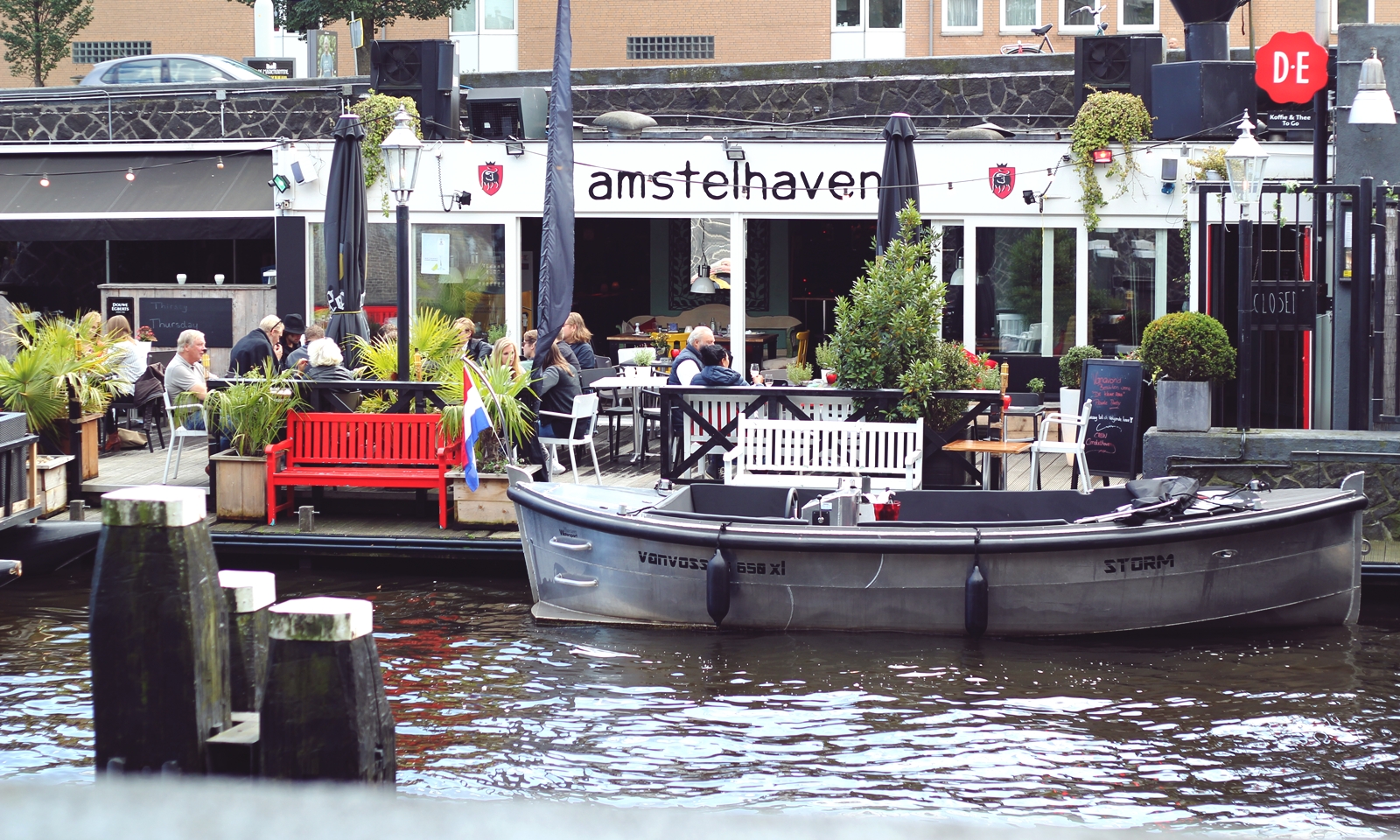
5. Amstelhaven “Feel a bit chic in the water”
Amstelhaven
Opposite to the prestigious Amstel hotel, it has one of the nicest terraces in town. Great place to sit by the water on a sunny day, enjoy a beer, and watch the boats go by. It has a nice interior with a modern touch including chesterfield sofas as well. It gets wonderful at night. It has all sorts of people visiting. Their dock is unique and with enough spots to moor, although usually crowded.

amstelhaven.nl/ | Mauritskade 1,1091 EW (Center)

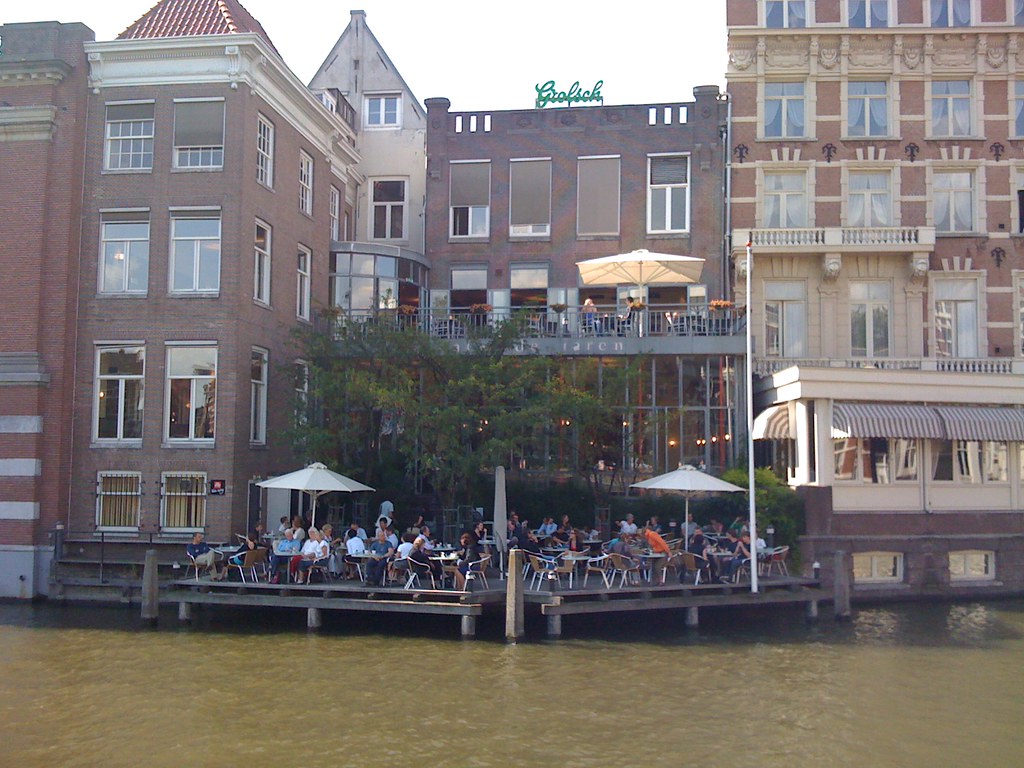
6. Cafe De Jaren – “Classy and cozy, with ample room for thought”De JAren
Big spacious café situated in the center of Amsterdam. It is classy and intelectual, but still low-key. One of those places that I keep coming to for it’s ambiance and chilled atmosphere. A bit intellectual as well. I love their colorful floor tiles. It has two floors and different areas to choose from. The dock for mooring is nice, although packed with tables and chairs, making it an adventure to get off your boat.

cafedejaren.nl | Nieuwe Doelenstraat 20-22,1012 CP (Center)

7. Brouwerij ‘t IJ  “The place where high percentage beer happens”Browerij IjBased at the side of the Niewuevaart canal and overviewing the Gooyer windmill. Its one of my favourites. They have a large terrace with long tables outside where you can sit at your ease, especially in summer. Inside, the walls present a huge collection of beer bottles. A great brewery with great selection of home brewed beers, ranging from lagers, up to pales or dark ones. Delicious snacks on the side. Their dock is lovely and small. Great spot to buy fuel as well, as there is a gas station right next to it. Beware: it closes at eight in the afternoon.

brouwerijhetij.nl |Funenkade 7,1018 AL (East)

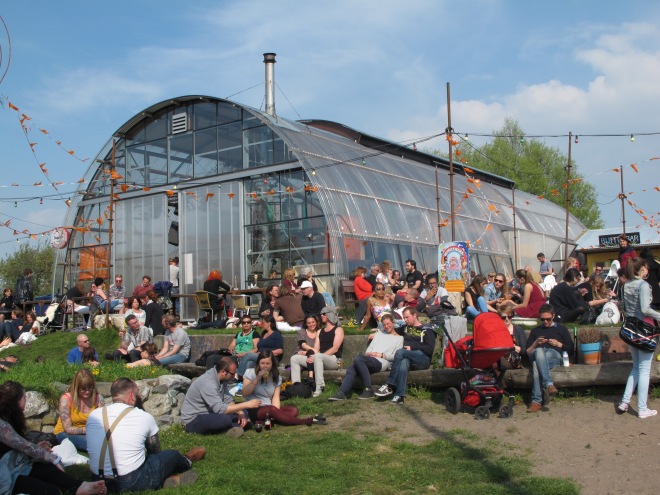
8. Amsterdam Roest – Like having fun on the beach, but in the city”
Roest
Roest at an industrial area involving an old steel factory and warehouses. I just love the vibe it has. Feels a bit like being in Berlin. Young crowd. Hip beauties. Selfservice. Take your drink from the fridge, checkout by the cashier. Find a couch or a bench and relax on the magnificent sand beach outside. The bar interior is one of its kind as well. Lots of space to moor your boat and even you can take a swim.

amsterdamroest.nl | Jacob Bontiusplaats 1,1018 PL (East)

9. Hannekes Boom – The perfect spot in town. A mix of everything”HannekesBoomOne of the most solid places for the summer. Decor and ambience is nice, and the outside seating area is outstanding. The colorful park-picning table setting makes it unbeatable. A lovely view to the Nemo museum and the whole of Oosterdok. One of my favourites for burgers. Super friendly staff. It has a fantastic log burner inside. Their mooring dock one of the best in town. although mostly crowded.

hannekesboom.nl/ | Dijksgracht 4,1019 BS (North)

10. Delirium Café – “The best of Belgium, at a boat’s reach”
delirium-cafe-amsterdam.01696903175f11af3853379f8806815339
Based at the side of the IJ, it is a great place to sample a HUGE variety of beers. Their menu focuses onbelgium drafts, but still counts over 800 different beers in total. The staff is knowledgable and helpful and the decor very comfortable and welcoming. The difficulty is that you cannot dock in their beautiful huge dock. Yet, as a proper Captain, you’ll manage to get tie your lines somewhere somehow.

deliriumcafeamsterdam.nl | Piet Heinkade 4-6-8,1019 BR (North)

11. Ill Pecorino “An Italian trattoria, across Central Station”
ilpecorino

You’ll find it across the IJ. The perfect spot to gain some perspective and have a look at the city, from the other side. Oriented as an Italian-trattoria, you’ll most likely to find the best pizzas in town. It has a lovely side dock to moor which offer both good shade and a lovely sun bath. Ideal to enjoy a sunset and get away from the crowds.

ilpecorino.nl/ | Noordwal 1,1021 PX (North)

12. De Ceuvel “A hidden paradise in the North Amsterdam”
Ceuvel
Enjoy getting to this hidden spot. Along the Buiksloter canal you’ll suddenly feel away from civilisation. This sustainable place that grows it’s own veggies and recycles objects into furniture has great, tasty and simple food, nice atmosphere and beer selection. It’s in a little district that has been made out of reclaimed houseboats. It’s a really cool place. It has a very unique and innovative feel. Completely different than the historic parts of Amsterdam

cafedeceuvel.nl | Korte Papaverweg 4,1032 KB (North)

13. Noorderlicht – “Outstanding spirit of freedom in nature”
Noordenlicht
Across the water from the main city you’ll find this greenhouse cafe that looks back towards town. It provides some of the best views you can find. On your way there, you’ll cross many cargo boats and ferries. It will demand both some sailing and safety skills, but its totally worth it.  This place fits perfectly in this edgy area of Amsterdam, called NDSM. It has a great garden and an interior with lots of colorfoul light fixtures. You need to dock in a floating platform a couple of meters away.

noorderlichtcafe.nl/ | 

14. Pllek – “The everlasting festival lounging experience” 
Pllek
Place of some of the best afternoons I ever had. You can easily spend all day in here.  A great venue made of containers and decorated with lots of taste.  The atmosphere is very cool and the beach is incredible wide. Their staff is great and the food was truly excellent. Relax with a view. The spot to dock is quite small and you need to make sure to fix some fenders to protect your boat. The tide can hit hard in that part of the IJ.

15. Pont 13 – “A classy refurbished ferry waiting to host a great moment”
Pont 13
A truly hidden gem. One of my favourite places for all times. Pont 13 is an old municipal ferry from 1927 with its large central space converted to a fine restaurant. The ferry has preserved most of its original details. It provides a great view of the port, where you can enjoy the houseboats, some storage silos, industrial buidlings and ships passing. Their dock is cute and almost always accesible. If the weather is right, you can tie your lines to the big yellow buoys and enjoy a wonderful swim as well.

pont13.nl/ | Haparandadam 50,1013 AK (North)

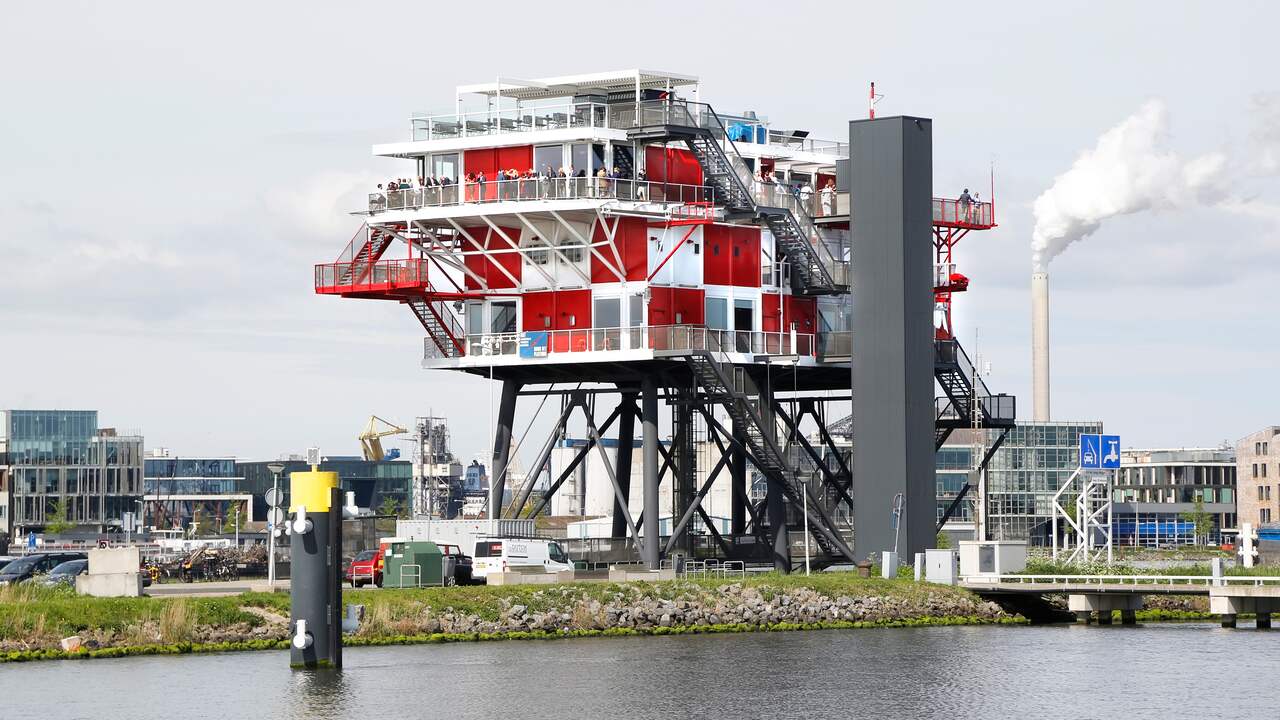
16. REM Island – “One of the best panorama views the city can offer”
REM Eiland
REM Island has a fantastic story behind. Offering 22 meters above the IJ, this vivid red, oil rig structure was in the 1960s a pirate radio and TV broadcaster platform. It now hosts an extraordinary restaurant. On the terrace, a 360-degree panorama offers one of the best views in town. Check out industrial docklands, iconic buildings and the passing river traffic. You make your way to the top through a windy metal staircase experience, if you are brave enough to avoid the lift.

remeiland.com | Haparandadam 45,1013 AK (North)

17. Café ‘t Smalle   “A piece of history in the middle of the Joordan”
Stmalle
Located at one of my favourite canal, this place is just cozy cozy cozy. In the middle of the Joordan, this typical Amsterdam café dates back to 1870, when it was initially a liqueor distilery. It has some  lovely large stained glass windows and a warm, friendly and gezellig atmosphere. Right across the hustle going on the other side of the Prinsengracht, at the Anne Frank Museum standing queue. Ideal for a Gin and Tonic and a piece of Apple pie. It has a relatively small suspended dock/terrace that makes it all wonderful.

t-smalle.nl | Egelantiersgracht 12,1015 RL (West)

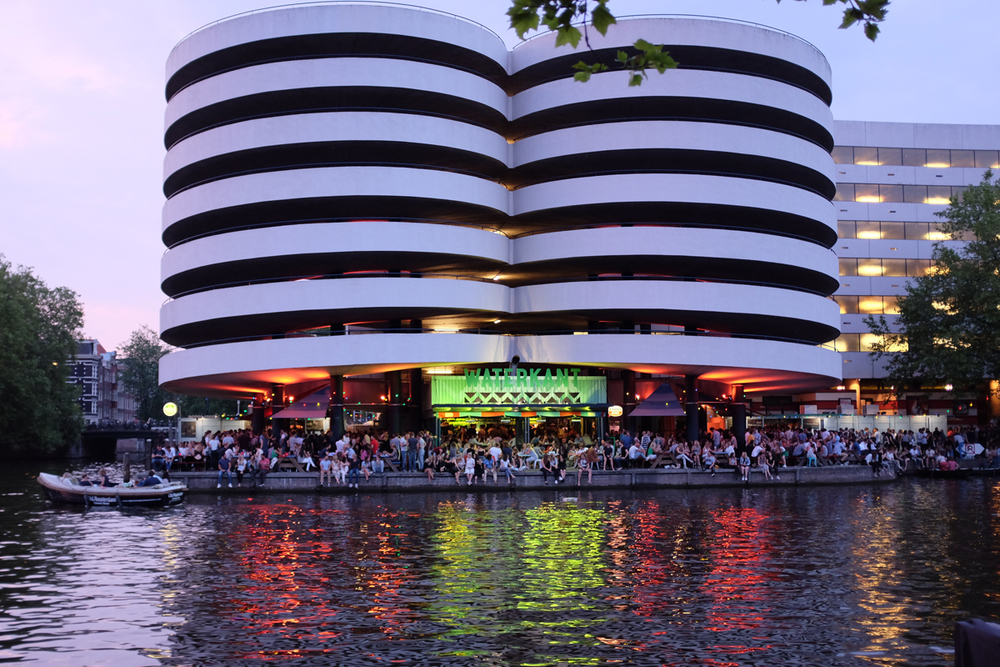
18. Waterkant – “The five senses of Paramaribo in the middle of town”WaterkantCurrent hotspot in Amsterdam. Below on a magnificent parking garage which was once intervened by artist Spencer Tunick. It has a lovely water view and fun contemporary interior. Fantastic atmosphere with a mix of young, old, locals and visitors. Pretty good Surinamese food. An opportunity to grab a traditional Parbo beer, some Gado Gado or even a chicken roti. Ample place to moor your boat as well, although usually crowded on a sunny afternoon. Yet, you wont be needing one of those difficult to catch tables on the terrace, as you’ll be having a private party in your boat. Great spot to buy fuel as well, as there is a Gas station right next to it.

waterkantamsterdam.nl | Marnixstraat 246,1016 TL Amsterdam (West)


19. Hotel Buiten – “Embracing nature in a place with a sustainable vision”Buiten
Cafe Buiten is known for having its own beach, accesible all year long and even in New Year. Revamping the neighbourhood since 2012, this place settles the initial groundwork for a future hotel to be constructed in the coming years. It has a wide dock welcomes you at all times. To reach there you’ll need to go through one of the two locks, either in the north or the south of Sloterplas. You’ll need to make a phone call to a number advertised on the spot for someone to open/close you. Ideal to enjoy the nature and woody rustic atmosphere.

hotelbuiten.nl | Th.J. Lammerslaan 1,1064 DH Amsterdam (North New West)

20. Restaurant Meerzicht – “Ideal after a long day of sailing”Meerzicht
Meerzicht is in the surroundings of the Nieuwe Meer lake. The journey to this spot in one of my dearest ones. It takes around 15-20 minutes to get you through the lock that levels the two meters height difference between the canal Schinkel and the lake. Then you weave your way off through an ample mass of water, with views to some harbours, the skyline of Amsterdam south and plenty of nature. The restaurant is large enough to seat you immediately when arriving unannounced. You can enjoy different views on either sides of the restaurant, or eat somewhere more central near the fireplace or the bar. Their dock/terrace is lovely under the sun. Ideal for after a whole day of sailing.

restaurantmeerzicht.nl | Nieuwemeerdijk 326,1171 NT Badhoevedorp (South West)

Do you know another bar to add to the list? Please make a comment below this post and I’ll do the scientific research. :p

Did you enjoyed this post? Please share it around so that others can benefit as well.

Can you include better picture? All pictures are taken from the internet and link to their original source. Some of them truly don’t make justice to the places or their interiors. I would suggest to check them out on your own. Eventually I’ll make a video to give this post a bit more life, and hopefully gather better pictures.

About me? You can get in touch via @aj_desalvo. This season you can also follow the Malbec’s adventures on Twitter #MalbecAms2016


What if?

What if what you think you want, is not what you need?
What if why you need it, doesn’t correspond with why you want it?
What if when you get it, its actually the right time, although you think different.
What if who gives it to you, is the person you less expected it from?
What if where you find it, is  better than when you first envisioned it?
What if how it comes to you,  exceeds your expectations about it in all sense?

In my opinion, there’s little you can actually do about shaping your desired outcomes exactly like you want them. And that its OK. I think one needs to come in good terms with that though.

When it comes to achieving stuff, of course there’s lots of attitude, focus and hard work. There’s also lots of favorable wind on your back. Valuable connections, sound contextual advantages and good luck. And there’s lots of this and that you can tell yourself about, if you believe in the self made man type of theories. All these things have an superb influence, true.

At the bottom of things, lot’s of the this and that is just the sugar coat to a huge aleatory system of things related to people. Because either we like it or not, we all depend from others to move forward (Or backwards, or sideways). Since we are born until we fly somewhere back on the space ship, we relate to others. And those others will most likely have an influence in your expectations of the way things con through.

And what if things don’t come as planned (Do they ever will?) but they come much better than you thought in the first place?

And what if things coming your way exceed your expectations in every way?(Trust me, many times they’ll will.)

If so, then you’d wish you hadn’t let things kept you sleepless overnight for so long. What if I trust how things will turn out, letting life surprise you each day?

They say John Lennon once said: “Everything will be okay in the end. If it’s not okay then it’s not the end”

I kind of like John Lennon’s words, a lot, lately.

I think the plan is to…

I think the plan is to push your limits and erase that self draw line in the sand.  (Until you reach that moment a bit to close of things being un-enjoyable.)

I think the plan is to make your temper go further and stronger than the unimaginable. ( And play around with life in the meantime.)

I think the plan is to learn from other people’s limitations without judging them. (And only support them if those you want to help allow you to do so.)

I think the plan is not to go to a parties were you are not invited. (And if so, only talk when others want to hear your opinion.)

I think the plan is to be OK when others decided to step into your words. (Silence speaks louder than words. And we need to learn how to listen more, and talk less.)

I think the plan is to laugh, have fun, and be grateful. (And show others how being serious is not that important in life.)

I think the plan is to avoid a 19th century drama. (Nor fight or convince anyone of what they are not interested in changing  their minds about.)

I think the plan is to do the best work possible. (Of course, in the limitations of the contexts you operate in.)

I think the plan is to write yourself into existence the most you can. (And do it better every time.)

I think the plan is to be grateful, active and happy. (We cannot afford to be idle.)

I think the plan is to enjoy today. (Because someday there wont be no plans anymore. And looking back, it will all seem superfluos, worrying all along about plans.)

==

First drafted on 18 Dec 2015.

Life will always surprise you

Being at the crossroad means having one spare option too much.

At some given point you’ll need to take a decision. If you don’t take one, life itself will take it for you. And that’s OK too.

It might not be what you want it to be. It might be even better. An unexpected turnaround. A pleasant surprise.

The time buffer to decide on your own is always unknown. You might have a few days. Sometimes even months. Sometimes just a few seconds will be enough to do the trick. But if you keep on drifting, life will finally move you away from the axis of uncertainty, at its own will.

And that’s OK too.

Because that’s what life does: it always surprises you.


Being at the crossroad

Being in dichotomy means having a spare option.

At some given point you’ll need to take a decision.

Will you turn left or right?

Will you go up or down?

Will you keep on straight or take the curve?

Will you say yes or no?

At some given point, being in the land of “maybe” is not an option anymore. It becomes unbearable to stay in such position.

At some given point, you’ll need to cut the lines.

There will be another life line to hang from someway along the path.

You just need to trust that. (And yourself.)

The long and winding road

In the end, all you have is the road to enjoy.

It comes in days. Dosified in 24 hours. Full of minutes which are 59 seconds too long.

That’s what is all about. Enjoying the road.

Pick any one of those “This is it! I made it!” moments you ever had. I am sure you can grasp them if you lay to think for a moment.

How long did those last? Not too long right?

I experienced some of those in my life. Times when things were pretty much all aligned. It didn’t lasted long. They faded away. Fast.

I guess that’s the nature of life. We are part of living, moving and changing environments. Full of those parts of the movie when something changes and goes wrong. It gets windy and stormy. With multiple curves and twists.

You would have paid a ticket to see a 1918 transatlantic boat go from London to New York City, arriving safely with everyone happy on board?

Goals have shaky shapes. They are aereal. Intangible until you materialise them. Yet, there is always some sort of “shape gap” between the initial idea and the achievement itself.

Have you actually managed to put our teeth in the bone we wanted? Most likely, if you did, It might have happened that life caught you busy chasing the next one. Even feeling behind schedule to the next adventure.

Are you still waiting to reach that goal that will change your life and make you happy for ever? Stop chasing unreachable bones. Take a look around. That’s this day. It might get windy and stormy, but that bone is today.

In the end, all you have is the road to enjoy.

My second energiser

“Could you do an energiser for the group, after the coffee pause?”

The question came to me out of the blue. I was participating of a kick off program. The venue involved 46 people from four different NGO organisations. We had a super packed agenda. Discussions begun at 8:30 in the morning and concluded at 18:00pm. Most of the present people have seen each other for the first time, that morning. The time keeping was excellent. Yet, the topics were initially very “high level stuff and hard to narrow down” stuff. After lunch, you could see everyones energy levels dropping down.

“You better ask my colleague Marten to do it. He is good with energisers” I replied. My answer was not what she was hoping for. One could notice by the looks of her face. Five minutes later, Ingeborg came back to me. “I reached out to your colleague. He says I should get in touch with you. That you are the best with energisers”. We both laughed. I couldn’t get myself out of the hook, it seemed. “Ok, I’ll do it.”, I replied.

I had little time to come up with something interesting. Looking back, I’ve only done one energiser in my life. Back then, I had over three days of time to think about it. This time, the call came short notice. My first step was to define some answers to an important question: “What do I want to achieve?”

I wanted people to:

– interact with each other in an active way.
– invite them to take decisions, collaborate and solve a challenge.
– have a laugh in the meantime
– share something personal with the rest
– be part of something we can document and share with others

Thus, I created a unique energiser for that specific group, in that moment in time. I branded it “The wash-IT #happy #people #colourful palette selfie”.

The energiser involved two components.

First asking people to look at their upper body part. Their torso. And define which was the most predominant colour in their clothing. I, for example, had a white shirt. Others had a green sweater or a blue dotted blouse. Those with non plain pieces of cloth, had to decide and go for the colour that covered most of the surface of their clothing. When you get an animal print, or a floral blouse, that’s fun to see. How in the world would they choose? I’ve seen some crazy patterns that morning. Then I asked  everybody to form a line, and organise themselves according to colour scale, in crescendo. From the lightest to the darkest. In the middle, you could see all the yellows, oranges, greens, light blues, purples and so up to black. It took around four minutes to get it right. People was laughing, giggling and interacting with each other to solve the dilemma. “Should I go before of after you?” “Doesn’t green go after orange?” “No, no no, you should come over here”. And so on. “But hey! Wait Alvaro. What is the selfie component in all this then?” Catarina asked.  ? Once the line was ready and colourfully ordered, I took my smartphone out of the pocket. I asked every one to smile, and we shot a picture to document the whole thing. You can see it here.

The second part involved getting a bit more personal. Thus, I asked everyone to grab a colleague by their shoulders. This meant organising people in pairs. Each one should provide and share an answer to the question: “What makes you happy?”

I talked about how much I enjoy living in Amsterdam, and cruising through the Amsterdam canals in my boat. Patrick talked about how he loves doing things outdoors. He said he also had sailing boat and he liked going out to a lagoon with his kids. We found out that we had that in common. We agree on going cruising together at sometime during the year.

Looking around, everyones energy was thriving. At a point, we even had to interrupt the energiser. Otherwise, we would have stayed ten more minutes, delaying the agenda for the day.

It was fun, and people liked it.

“You can be confident and proud about your energising skills”, said my colleague Marten.

Get people talking about what makes them happy, and many barriers will disappear, I concluded.